


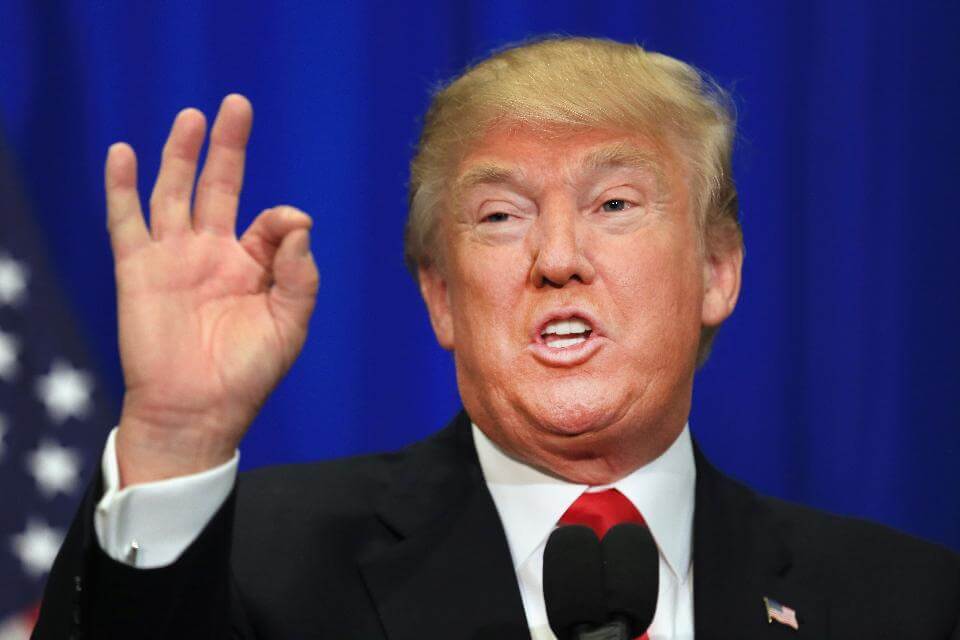
A great little article on Middle East Online gives us some wonderful insight into the trials and tribulations of professional Arabic translators who are currently trying to translate President Trump’s English into something understandable by Arabic speaking audiences.
One of the key problems facing Arabic language translators is that Trump speaks in a very particular way; a simple way that can very difficult to translate into a language known for its subtle complexities.
For example, Trump tweets and speaks in basic, colloquial American English – translators then have the challenge of essentially toning the language down in Arabic to try and capture the same intent.
A Carnegie Mellon University Language Technologies Institute “readability analysis” of Trump’s campaign speeches found that Trump’s answers during the US Republican debates scored at the fourth-grade reading level (or the average for a 9- or 10-year-old).
Professional Arabic translator Al-Mustafa Najjar believes the readability test results do not reflect accurately on the President:
“Translating Donald Trump is like translating a 5-year-old. It’s easy and challenging at the same time. It is easy in the sense that the lexical and grammatical simplicity of his language means less work for me as a translator. However, the challenge lies in the ability to follow the thread of his random and disorderly style.”
Egyptian translator Rawan Gharib, who works as a translation editor at Global Voices, said Trump provides a particular challenge for translators:
“The content must be comprehensible and the problem with Trump’s speeches is that he himself sometimes seems not to have any sense of awareness of where he’s going next or the point he’s trying to make. It’s usually hard to follow him (as a listener) because there isn’t any logical sequence of thoughts, so imagine how hard it would be as a translator. And that’s not to mention the limited, poor vocabulary and the vicious boring circles [of his speeches].”
It seems this problem is not confined to just English to Arabic translations. French translators too struggle as explained by Bérengère Viennot who spoke about the challenge of translating Trump in a report for the Los Angeles Review of Books.
“His vocabulary is limited, his syntax is broken; he repeats the same phrases over and over, forcing the translator to follow suit. Trump seems to go from point A (the question) to point B (himself, most of the time) with no real logic. It’s as if he had thematic clouds in his head that he would pick from with no need of a logical threat to link them.”
Japanese translators also struggle to find the right words it seems when it comes to Trump. “He rarely speaks logically and he only emphasises one side of things as if it were the absolute truth,” says interpreter Chikako Tsuruta in the Japan Times.
“He is so overconfident and yet so logically unconvincing that my interpreter friends and I often joke that if we translated his words as they are, we would end up making ourselves sound stupid.”
‘Trump Translations’ it seems are a special challenge around the world!


